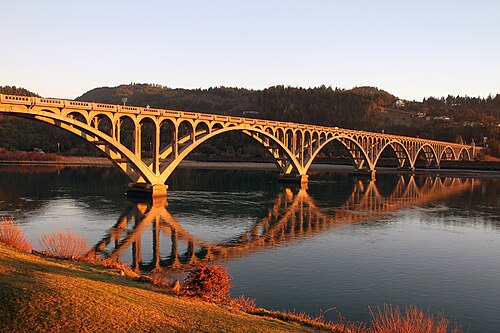
McCullough didn't play it safe. When Oregon's master bridge designer took on the Rogue River crossing in Gold Beach, he decided to import a radical French engineering technique. The site presented brutal coastal winds. He chose a Freyssinet arch design, named after its French inventor. This method required workers to place high-pressure hydraulic jacks directly inside the crown of the massive concrete arches. They jacked them apart. This countered natural shrinkage before workers poured the final concrete keys. Nobody in America had tried this yet. It worked. By tensioning the seven 230-foot spans this way, McCullough saved tons of material and created a lighter, stronger structure that easily handles the corrosive Pacific salt air.
Before the bridge opened in 1932, getting across the Rogue River was a slow mess. Travelers had to wait for a tiny, unreliable ferry. Sometimes for hours. This bottleneck choked off the flow of goods and tourists along the newly minted US Route 101. So, they built a 1,898-foot concrete giant to connect the coast. It changed everything. Loggers could suddenly ship timber south to California without waiting on the tides. McCullough didn't just focus on utility, though. He decorated the structure with soaring, Art Deco obelisks and intricate gothic arches on the underdecking, proving that public infrastructure could double as art.




.jpg)