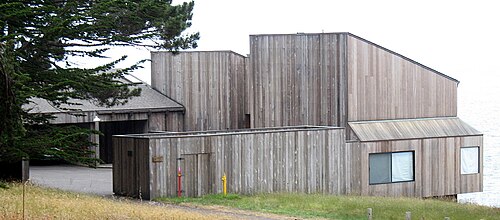
The wind never stops. When the architectural firm MLTW-comprising Charles Moore, Donlyn Lyndon, William Turnbull, and Richard Whitaker-set out to build Condominium 1 in 1965, they did not want to block the Pacific gale they wanted to ride it. They succeeded by clustering ten individual wood-framed homes into a single, weathered redwood fortress that looks less like a luxury development and more like a collection of old barns huddling together for warmth. No manicured lawns. Instead, Lawrence Halprin's master plan dictated that native bunchgrass and wind-sheared cypresses run right up to the unpainted timber walls.
Inside, the spaces feel like puzzles. MLTW used raw Douglas fir post-and-beam frames to carve out vertical volumes, squeezing bedrooms into lofts and placing massive concrete chimneys at the center of the living areas. It felt wild. Actually, this raw, eco-conscious aesthetic kicked off the "Third Bay Tradition," a design movement that rejected suburban sprawl in favor of living in partnership with the local climate. Critics raved. But local developers just copied the diagonal wood siding and shed roofs, stripping away the deep ecological philosophy until the style became a hollow clich of 1970s dental offices.
Today, Condominium 1 stands as a monument to a brief moment when developers actually cared about the earth. In 2005, it hit the National Register. This was a massive honor for a complex that was barely forty years old, proving that its radical architectural DNA still mattered to historians. The wood is grey now. Decades of relentless salt spray and biting Pacific fog have bleached the redwood siding to a ghostly silver. It looks permanent. But it remains a fragile experiment in how humans might share a coastline without ruining it.