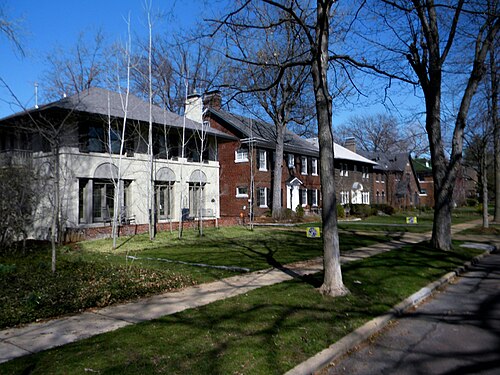
Cross the western border of St. Louis city into Clayton and the grid dissolves. That is by design. Developers in the early 1900s wanted to escape the smoky, industrial chaos of downtown without losing urban convenience. The Hi-Pointe--De Mun Historic District represents this exact sweet spot. It was a streetcar suburb that grew up just as cars started taking over the roads. Walk down De Mun Avenue today. You will see three-story brick apartment buildings standing shoulder-to-shoulder, their Tudor arches and limestone trim looking like a slice of 1920s Chicago. But look closer. Henry Wright, a master town planner who later designed famous planned communities in New York, laid out the De Mun subdivision in 1917. He ditched the rigid grid. Instead, he drew curved streets that hugged the natural hills, creating intimate, shared backyard courtyards that forced neighbors to actually talk to each other.
It is not just about the fancy layout, though. The district boasts a dense mix of single-family homes, massive luxury flats, and commercial storefronts that kept residents from needing to travel for groceries. On the Hi-Pointe side, the houses lean heavily into the eclectic revival styles popular after World War I. Think steep slate roofs, clinker brick, and quirky little towers. Then you have the commercial anchor. The Hi-Pointe Theatre opened its doors in 1922 at the intersection of McCausland and Oakland. It still sits there today. It is the oldest continuously operating movie theater in the entire metropolitan area. Audiences back then paid a dime to watch silent films under its distinctive cupola. Now, people buy craft beer and indie film tickets. That blend of high-density housing and walkable commerce made the neighborhood a blueprint for modern "new urbanism," long before anyone coined that trendy term.
What Makes Hi-Pointe--De Mun Historic District Special: