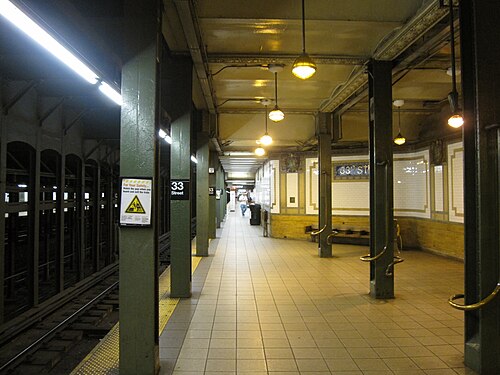
On October 27, 1904, the first IRT subway line opened to a frenzy of excited New Yorkers. The 33rd Street station was one of the original local stops. It was different. Designers George L. Heins and Christopher Grant LaFarge wanted to make this subterranean world feel less like a dark, terrifying coal mine and more like a public palace. They used glazed tiles. These weren't just cheap finishes, though they ordered custom ceramic plaques from the Grueby Faience Company in Boston to decorate the underground walls.
Look closely at the platforms today. You will see ornate majolica cartouches featuring a spread-winged eagle. This emblem paid homage to the 71st Regiment Armory, a massive brick fortress that once loomed over 34th Street. But the art had a job to do. In 1904, New York was flooded with international immigrants who could not read English. The distinct eagles and large terracotta "33" plaques told riders exactly where to get off. No reading required.
Decades of train soot and clumsy modernization efforts nearly ruined the historic fabric. But workers saved it. During a massive restoration, preservationists scraped away layers of grime to expose the vibrant greens and deep blues of the original Grueby tiles. The station joined the National Register of Historic Places in 2004. It stands as a physical chunk of 1904 Manhattan, functioning exactly as it did over a century ago. Just with louder trains.
What Makes 33rd Street Subway Station (IRT) Special: