The Mississippi River was once wild. During the dry summers of the late 1920s, heavily loaded barges frequently ran aground on shifting sandbars, prompting Congress in 1930 to authorize a massive scheme to carve out a permanent nine-foot-deep channel. Lock and Dam No. 17 near New Boston was a vital cog in this system. Laborers poured tons of concrete and riveted massive steel gates into place during the height of the Great Depression. They finished the main lock in 1937. It changed everything. Before the dams, captains had to guess where the deep water lay, but now the Army Corps of Engineers controlled the pool levels with mathematical precision.
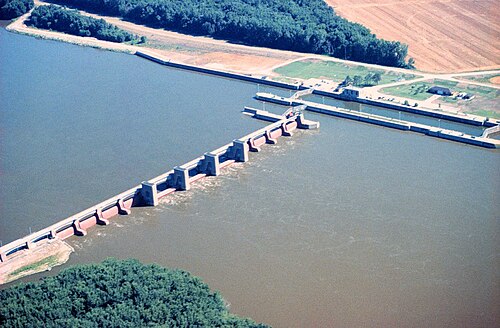
Think giant steel teeth. The dam uses three massive roller gates and several smaller Tainter gates to hold back the river. These rollers, giant steel cylinders that can be raised or lowered, look like industrial boilers suspended between concrete piers. They spit out excess water during spring floods. The lock chamber itself measures 110 feet wide by 600 feet long, a standard size that allowed entire towboats and their barges to lock through in one single, sweaty hour of operation.
The site also boasts some pretty distinct architecture. The control house features stripped-down, industrial Art Deco styling, which was the federal government's favorite way to make utilitarian structures look grand and futuristic in the 1930s. Actually, drivers passing the cornfields of Mercer County today probably just see a concrete barrier. That is a mistake. This complex represents the exact moment humans finally bent the Mississippi River to their will.
What Makes Lock and Dam No. 17 Historic District Special: