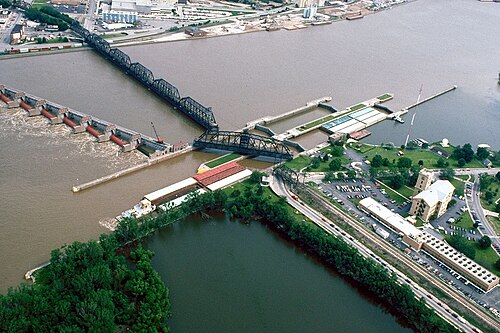
In the middle of the Great Depression, the federal government decided to tame the Mississippi River. They started with Lock and Dam No. 15. Completed in 1934, this massive concrete structure spans the river between Rock Island, Illinois, and Davenport, Iowa. It wasn't just another construction project. It was the first completed piece of the ambitious Upper Mississippi River 9-Foot Channel Project. Congress wanted to make the river a reliable highway for barges. The Army Corps of Engineers chose this exact spot to tackle the notorious Rock Island Rapids. They built the largest roller dam in the world. It stretches 1,203 feet across the water, utilizing eleven massive steel rollers to control the flow.
Most dams use slide gates. Not this one. The engineers needed to clear heavy spring ice without jamming the machinery, so they went with those giant cylindrical rollers. Each steel tube cranks upward. This allows raging river water and heavy blocks of ice to rush underneath. It worked. Actually, it worked so well that it became the prototype for the rest of the river's lock system. The site also includes two locks side-by-side. The main lock chamber measures 110 feet wide by 600 feet long. That's big enough to swallow a whole tow of barges. The smaller auxiliary lock sits right next to it, unfinished but still functional for smaller craft.
Beyond the cool engineering, the district represents a massive shift in how America used its natural resources. Before this project, navigating the Rock Island Rapids was a literal shipwreck hazard. Steamboat pilots dreaded this stretch. By drowning the rapids under a controlled pool of water, Lock and Dam 15 essentially tamed the wild upper river. It turned a seasonal gamble into a predictable commercial corridor. The construction itself also kept hundreds of local men employed during the worst years of the Depression. You can still see the original brick control houses. They look like little military bastions with their clay-tile roofs. They still operate today. A working piece of 1930s infrastructure that never actually retired.
What Makes Lock and Dam No. 15 Historic District Special:
Lock and Dam No. 15 Historic District Location Map: