President Hoover signed the bill. In 1930, amid the crushing weight of the Great Depression, Congress approved the massive Nine-Foot Channel Project to tame the wild Upper Mississippi River, transforming it from a seasonal gamble into a dependable watery highway. Bellevue, Iowa, became a chaotic hub of steel and sweat when construction began on Lock and Dam No. 12 in 1934. Hundreds of desperate men found work. They poured tons of concrete and wrestled massive steel gates into place, battling the river's unpredictable currents until the site went fully operational in 1938. Actually, it wasn't just about jobs. The project fundamentally shifted how the Midwest moved grain, coal, and oil.
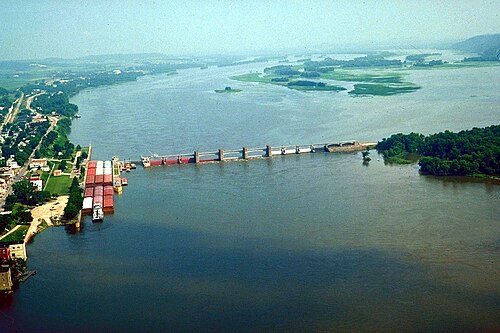
The main lock measures 110 by 600 feet. To control the fierce flow of the Mississippi, engineers installed three roller gates and seven Tainter gates, massive steel structures that could be raised or lowered to maintain a consistent pool depth. Pure industrial muscle. But they also cared about aesthetics. So, the architects added subtle Art Deco flourishes to the brick control houses, making these utilitarian structures look surprisingly stylish against the muddy Mississippi.
National recognition came in 2004. This designation recognizes the lock and dam not just as a functioning piece of infrastructure, but as a remarkably intact example of 1930s river engineering and New Deal state-building. Amazingly, the original machinery still does the heavy lifting today. It still works. While modern electronics have replaced some manual valves, barges still squeeze through the same concrete chamber built by Depression-era laborers nearly a century ago.
What Makes Lock and Dam No. 12 Historic District Special: