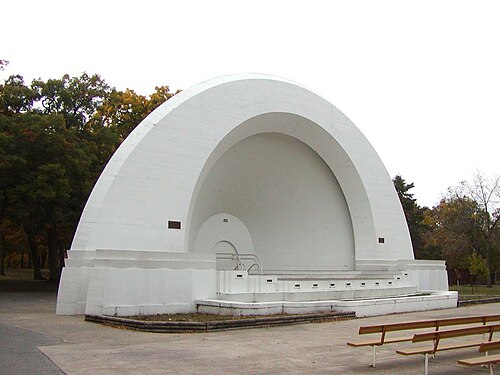
The Great Depression hit Fort Dodge hard. But in 1938, federal Works Progress Administration cash injected new life into the town. They built a band shell. Architect Henry L. Kamphoefner drew up the blueprints, rejecting the tired, dusty Victorian gazebos of the past for something aggressively modern. He wanted concrete. Specifically, a massive, monolithic arch that cost around $30,000 and kept dozens of local, out-of-work relief laborers sweating for months. This bright white structure rose out of the dirt to give locals a free place to escape their daily worries.
Kamphoefner was obsessed with acoustics. He designed the shell as a true mathematical paraboloid. This shape meant sound waves bounced directly toward the audience, completely eliminating the need for microphones or speakers. Even a whisper on stage carried to the back row. Musicians loved it. Karl King, the legendary circus bandmaster, regularly led his Fort Dodge Municipal Band here. They played brassy march music that echoed across the grass to thousands of people sitting on picnic blankets. It was an acoustic megaphone.
The pavilion joined the National Register of Historic Places in 2003. It stands as one of the finest surviving examples of Streamline Moderne public architecture in the Midwest. Most of these Depression-era structures cracked, crumbled, or met the wrecking ball decades ago. Not this one. Fort Dodge kept maintaining it. Today, the concrete still gleams under the Iowa sun, a gritty reminder of a time when the federal government actually funded beautiful, permanent art for everyday, working-class citizens.